Gordon Cooper
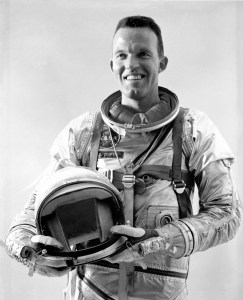 March 6, 1927 – October 4, 2004
One common denominator amongst pilots – test pilots, in particular – is a love for speed. The need to go faster. To push limits. This desire is ideal when you are piloting prototype jets that have never been piloted before. It’s essential if you want to be crazy enough to strap yourself to a 260,000 pound rocket and launch into the unknown vastness of space.
Leroy Gordon Cooper Jr. loved speed. Thanks to his parents’ love for planes and his father’s service as a military pilot, Gordon learned to fly at a young age. He earned his first certification at the age of just 16. He enlisted in the United States Marines after high school, but World War II ended before he could be deployed. He was eventually discharged from the Marines and joined the Army ROTC (Reserve Officers’ Training Corp) in college. He entered flight school for the U.S. Air Force and earned a degree in Aerospace Engineering. He naturally became a test pilot alongside friend and classmate, Gus Grissom, and logged more than 2,000 hours as an experimental pilot.
In 1959, Cooper received orders to report to Washington D.C. It was there he found out he was on the short list for a new manned space program called Project Mercury.
Fast forward through the selection process and Gordon Cooper was eventually named to the Mercury program. He was the youngest of the seven astronauts selected. During the early missions, Cooper served as Capsule Commander for flights by Alan Shepard and Scott Carpenter. He was the backup pilot for Wally Schirra’s Mercury-Atlas 8 mission. He was finally able to command Mercury-Atlas 9. The mission would make Cooper the first American to sleep in space and, in total, he spent more time in orbit than the other Mercury Seven combined. There were a number of technical mishaps, but Cooper was able to manually pilot the capsule (which he named Faith 7) home safely. Mercury-Atlas 9 would be the last Mercury Mission.
Cooper moved on to Project Gemini and commanded Gemini 5 – an 8 day mission that proved humans could endure the time it would take to make it to the moon. He also transitioned to the Apollo program, but never flew a mission. This was due, in part, to his strained relationship with former Mercury Seven colleague and Director of Flight Crew Ops, Deke Slayton. Cooper retired from NASA and the Air Force in 1970.
Though decorated, Cooper’s career with NASA was anything but smooth. When not training for or flying in space, Cooper loved to race cars and boats. He was often chastised by NASA for putting himself in danger during races. It was also discovered during the initial Mercury selection process that Gordon and his wife, Trudy (herself, a pilot) had separated. In order to maintain the “family man” image of the astronauts, Gordon and Trudy agreed – at NASA’s behest – to put on the guise of a happily-married family for the public. They remained together until he retired, at which time they divorced.
Cooper spent his retirement serving on a number of company boards and remaining heavily involved in racing technology, both on land and water. He ran a consultant firm that advised on everything from car parts to real estate development. He even worked briefly for Disney as head of research and development for their new EPCOT project. He died at his home in California from heart failure at the age of 77.
Burial
Specific Location
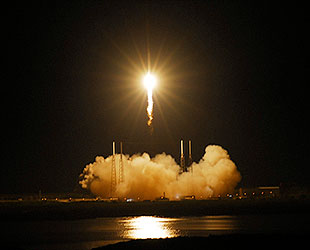
Gordon’s cremated remains made TWO trips into space. The first was a sub-orbital SpaceLoft launch that also included the ashes of Star Trek star, James Doohan, and returned to Earth. A second launch from SpaceX (pictured above) carried a portion of Cooper’s ashes into Earth’s orbit, where they were released.
 Celebrity Graveland
Leave a comment